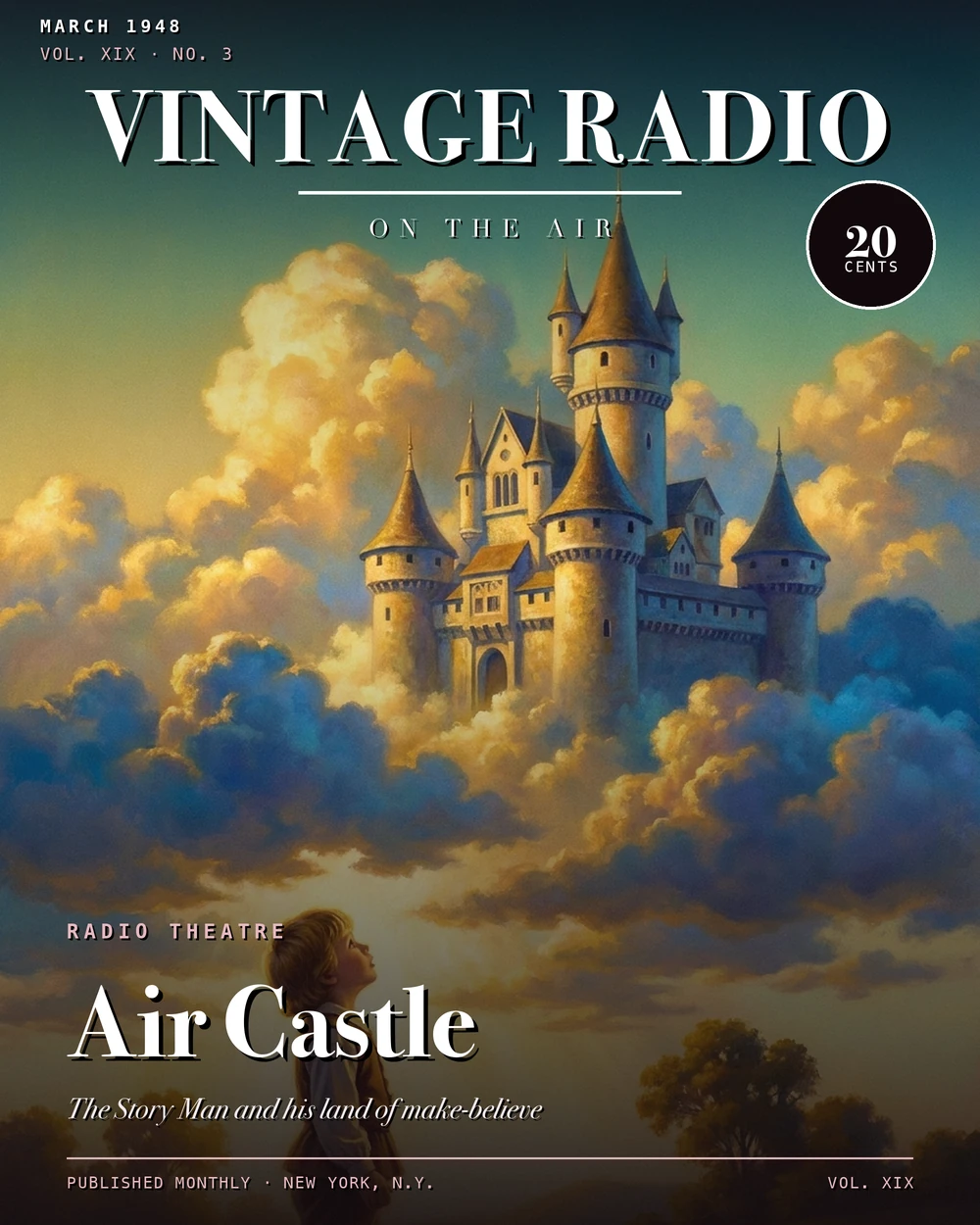
Air Castle
One Man Built a Castle
What made Air Castle unusual from the start was how completely one person built and inhabited it. Baron Keyes, a staff announcer at Los Angeles station KPLA, created the show himself, wrote every line of dialogue, composed and performed all the songs, and voiced every single character. When the program debuted on KHJ on February 13, 1928 — two days after leaving KPLA — listeners were tuning in to one man's fully realized fantasy world. That's a remarkable thing to pull off, and the fact that the show grew popular enough to be syndicated across the western United States suggests Keyes pulled it off well.
The central figure was the Story Man, Keyes himself, whose smooth tenor voice opened every episode with a signature greeting and invited the audience into the "land of make-believe." The Air Castle wasn't just a title — it was a place, a fantasy castle that served as the consistent setting for the show's adventures. Story Man would interact with the castle's recurring inhabitants, tell a short story, and then return to the "real world" at the close of each episode, already anticipating his next visit. It had the quality of a ritual, and children came to rely on the rhythm of it.
The Characters Who Lived There
The Air Castle was populated by an eccentric cast, all of them voiced by Keyes — Clickety-Clack the wooden man, Yip the wooden dog, Wooly the puppy, Happy Duck, Bugler Murphy, President Pip, the Gnome King, and Captain Jinx, among many others. The sheer number of distinct personalities Keyes maintained is impressive on its own.
What made it work on radio was a clever device: many of these characters didn't speak in actual words. Clickety-Clack communicated through tapping sounds; Bugler Murphy's voice came out like a tooting horn. After each character's noisy contribution, Story Man would step in and interpret what they had said for the listening children. It turned a technical limitation — one performer doing everything — into a signature feature. The kids at home had to follow along with Story Man as he translated the gobbledygook of the castle's inhabitants, which kept them actively engaged rather than just passively listening.
The show was originally aimed at preschool-aged children and aired from 9:30 to 10:00 in the morning. When the audience response made clear there was broader appetite for the program, it shifted to a 5:00 p.m. slot, positioning it to reach school-age children coming home at the end of the day.
From the Radio to the Stage
The show became popular enough that fans wanted more than the audio — they wanted to see these characters in person. Keyes responded by turning the most popular Air Castle residents into marionettes, and he eventually performed three live shows every Saturday at the Beaux Arts Theater in Los Angeles, bringing Clickety-Clack, Happy Duck, and the rest of the castle into physical form for audiences who had only ever heard them.
That kind of engagement — children and families following a radio show's characters into a live theater — speaks to how thoroughly Keyes had built something that felt real and habitable. The Air Castle wasn't just a backdrop; it was a destination that listeners wanted to visit in whatever form they could.
Networks, Sponsors, and a Shifting Format
Air Castle had an active broadcast life that moved through several configurations. Starting on KHJ in Los Angeles, the show reached San Francisco as well before NBC syndicated it to nine stations across the western market. It also moved between networks during its run, shifting from the Don Lee network to the first version of the ABC network and then back to Don Lee. Union Oil Company was among the sponsors who supported the show along the way.
The format itself changed considerably. The show started at 30 minutes, expanded to an hour, then contracted back to 30 minutes, and eventually settled at 15 minutes. That kind of compression often signals the practical realities of radio scheduling and advertising economics rather than any decline in the show itself — many successful programs of the era went through similar adjustments as networks and sponsors renegotiated what they needed.
What Survived
Fifty-two episodes have been preserved, with a total running time of roughly 11 hours and 27 minutes. The catalog identifies them by number, with surviving recordings including episodes 157, 158, 159, 163, 164, 167, 169, 172, 173, 174, 175, and 177, among others. Those numbers are telling on their own — if what's preserved begins around episode 131 and reaches into the 170s, the show clearly built a substantial catalog before those recordings were made. What's left to us is a window into a later phase of a longer run.
A detailed article titled "A Man and His Air Castle" by Doug Hopkinson appeared in a July/August 2011 old-time radio newsletter. That piece drew on interviews with Baron Keyes' family members and audio transferred from original transcription discs — a meaningful act of documentation for a show that might otherwise have remained entirely obscure.
Why It Holds Up as a Piece of Radio History
Air Castle is a West Coast regional show that never achieved the national fame of some of its contemporaries, but it represents something worth noting: a very early attempt to create a sustained fantasy world for children on radio, maintained almost entirely by a single performer. The show debuted in 1928, making it one of the earlier dedicated children's programs in American broadcasting. Keyes wasn't working from an established template for this kind of show; he was building one.
The moral texture of the stories — lessons about kindness, bravery, and friendship woven into the adventures — wasn't unusual for children's programming of the era, but the delivery mechanism was distinctive. Rather than straightforward narration, Keyes created an interactive feel through the Story Man's dialogue with the castle's characters and his role as interpreter between those characters and the listening audience. Children weren't just being told stories; they were being invited into a conversation, even if only imaginatively. For a kids and family program from the late 1920s, that's a thoughtful approach to the medium.